Blog
100,000 Indian farms are now registered on Cardano
 Redacción CardumenCardano
On October 21, 2026, the Cardano Foundation announced a milestone that has nothing to do with price: 100,000 farm lands in India were registered on the Cardano blockchain. Each transaction on a public address represents an individual farm, and anyone can verify it on the explorer without asking anyone for permission.
We checked it ourselves: the address holds 100,075 transactions between February 24 and October 21, 2026. Eight months to go from zero to one hundred thousand.
This is not a token or a promise. It is real, production infrastructure giving smallholder farmers something they never had: a verifiable identity to access credit, insurance, and markets.
The problem: 100 million invisible farmers
India has more than 100 million smallholder farmers operating outside the formal financial system. Not because they don’t produce, but because they cannot prove who they are or what land they farm.
Their plot boundaries often go undocumented or disputed. Sustainability practices go unrecorded. Historical yield data is fragmented across disconnected systems. Without verifiable data, a bank can’t assess risk, an insurer can’t set a premium, and a premium buyer can’t confirm origin.
The result is a familiar paradox: the farmers who need financing the most are precisely the ones who can least access it. And every institution trying to help them must redo, on its own, the verification another already did — paying the full cost each time.
The solution: a satellite oracle on Cardano
The project is called Project Swaminathan, named after M.S. Swaminathan, the agronomist known as the father of India’s Green Revolution. It is coordinated by the Syngenta Foundation India, with its network of more than 26,000 “agri-entrepreneurs” (rural agents who already advise farmers), together with 5am.Earth, a foundation building the trust layer.
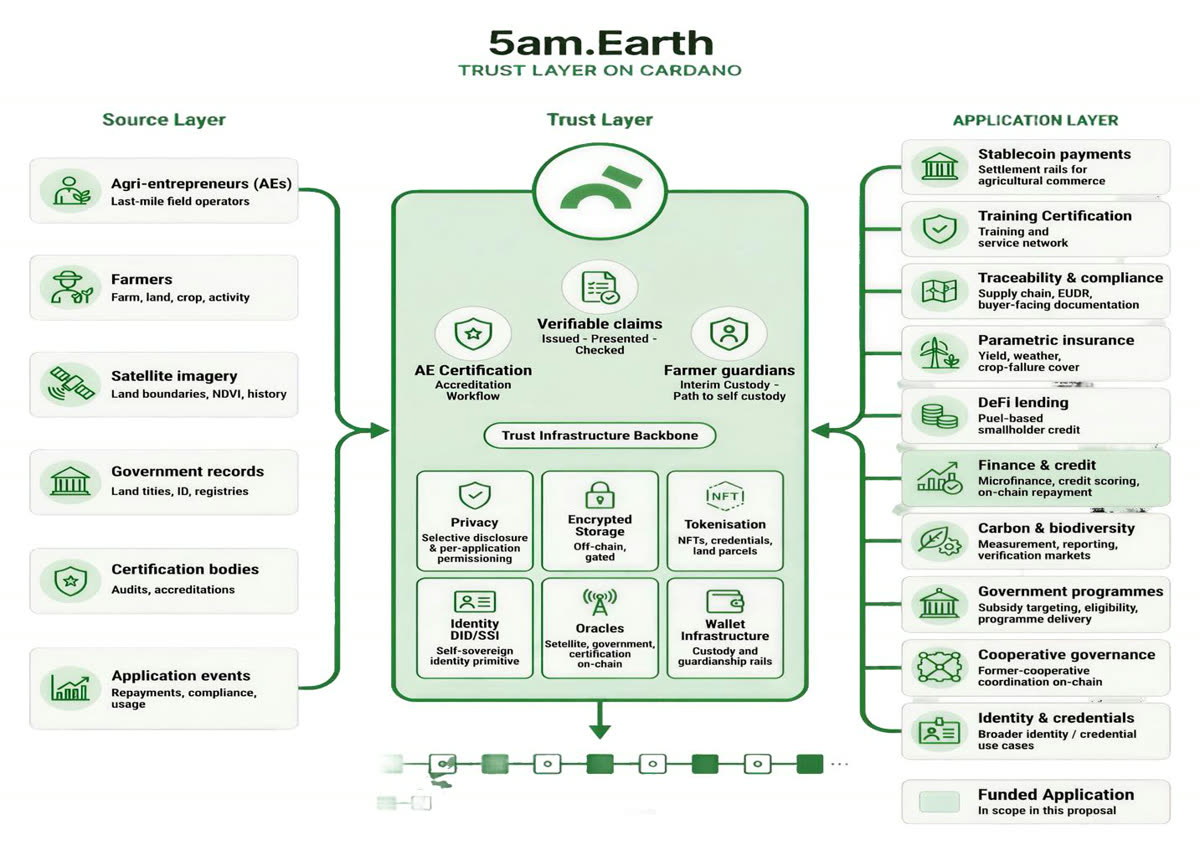
The idea is simple in architecture and powerful in effect: combine satellite Earth observation with decentralized identity to create verifiable records for each plot.
The flow has four steps:
- Plot identity. Each parcel is mapped with satellite imagery and receives a decentralized identifier (DID) tied to its verified boundaries.
- Sustainability index. Twelve years of biomass and crop data build a verifiable history for each plot.
- On-chain verification. Verified data is recorded on Cardano for independent validation.
- Institutional integration. Banks, insurers, and trading platforms consume that data without intermediaries reinterpreting it.
The key lies in what Cardano does — and what it does not do — with the information.
How it works: anchor, don’t store
This is where the project is most often misunderstood, so it’s worth being precise.
Cardano does not store the farm data, nor the identity identifiers. Those live off-chain. Identity runs on Veridian, the Cardano Foundation’s identity platform, which uses the KERI protocol (Key Event Receipt Infrastructure): self-certifying identifiers whose sensitive information stays in wallets and off-chain repositories under the farmer’s control.
What Cardano provides is the verifiable anchor: an on-chain hash registry. Each record is committed as a cryptographic hash, not as raw data. This serves two functions: it provides a timestamp (proof the data existed at that moment) and tamper evidence (if someone alters the off-chain data, the hash no longer matches).
This pattern is exactly what two Cardano standards describe: CIP-170 (KERI-backed metadata attestations) and CIP-190 (proof of existence via content hashes). The result is a system where anyone can verify that a record exists and is intact, without exposing the farmer’s personal data — especially relevant in India, where the law restricts the storage of certain national identifiers.
In short: identity is off-chain; the integrity proof is on-chain. That separation is what makes the system scalable and privacy-respecting.
From 1,000 to 100,000 in eight months
The growth is the most eloquent part of the story.
- March 2026: the first 1,000 farms registered.
- June 2026: 15,000 farms.
- October 21, 2026: 100,000 farm lands.
During the expansion months, the pace reached 500 registrations per day. And we verified it directly on-chain: the public address holds 100,075 transactions, each representing a farm, from February 24 to October 21.
Behind that number is an important detail: these are not cold records. They are plots mapped by satellite, validated in the field by a local agent, and linked to the farmer’s identity. Each transaction is a family that, for the first time, has a verifiable document to present to a bank.
Who’s behind it
The project was not built by a single company. It is a coalition of the Cardano ecosystem, and that is part of the message:
- Syngenta Foundation India contributes the field-agent network and agricultural knowledge.
- 5am.Earth coordinates the trust layer and foundation governance.
- AIquant, Anastasia Labs, and Andamio implement the satellite oracle and the technical layer.
- Veridian provides decentralized identity (KERI).
- NMKR, Zengate Global, DigiFarm, and others add tokenization, traceability, and satellite verification.
- Project Catalyst funded part of the development.
The infrastructure is financed through a 10 million ADA Cardano treasury proposal, approved by on-chain governance with 70.63% delegated-representative approval and a unanimous Constitutional Committee vote.
Why this matters for Cardano
Cardano was built on a thesis: to be financial infrastructure for those who never had access. This project is perhaps the most concrete example of that thesis in action.
It is not speculation. It is not a token market. It is real economic activity — farmers, credit, insurance, and traceability — flowing over a public blockchain. 5am.Earth’s vision targets 3 million farmers by 2030, with an intermediate path of 500,000 by the end of the funded period.
Critics will rightly say that registering a farm is not the same as a loan disbursed. The real test comes next: whether banks, insurers, and buyers use those records to make real decisions. But the first step — verifiable identity — was the one missing, and it has now been taken, a hundred thousand times.
Sources
- Cardano Foundation — case study “Verifiable farm data for inclusive agricultural markets”
- 5am.Earth — official site and treasury proposal (Cardano Budget 2026)
- Adastack Ecosystem Explorer — 5am.earth
- CIP-170 — KERI-backed metadata attestations
- CIP-190 — Proof of Existence Transaction Metadata
- On-chain address on Cardanoscan — verification of the 100,075 transactions
- Cardano Foundation — monthly update, June 2026