Blog
I Deployed a Partner Chain with AI and Metis Blew My Mind
 Redacción CardumenEducation
A few months ago, I tried to understand Metis. I cloned TxPipe’s official repository (github.com/txpipe/metis), read the documentation, tried to spin up a few components, and—spoiler alert—didn’t get very far. Kubernetes wasn’t my comfort zone, Helm even less so, and the idea of configuring complex clusters with strict secret management felt like a monumental overkill for what I needed back then. I shelved it and went back to my usual operator routine.
This weekend, however, I made a different decision: I wanted to move part of my infrastructure out of the commercial cloud and bring it to local, controlled environments. Not because of a deep philosophical epiphany, but for something much more pragmatic: I wanted direct control over physical machines, to measure actual resource consumption without intermediaries, and to understand with surgical precision what happens when a node goes down, without relying on a cloud provider’s opaque dashboards.
It was in that context that I reopened the Metis repository. And this time, assisted by an AI agent and TxPipe’s operational ecosystem, the experience was completely different. What used to look like an impassable wall of YAML files turned into a smooth, transparent orchestration.
What is Metis? The SuperNode Thesis
For those operating stake pools (SPOs) on Cardano who don’t have it on their radar yet, Metis—dubbed the SuperNode in TxPipe’s public vision—is a comprehensive blockchain infrastructure orchestration platform designed specifically to run on Kubernetes. The core premise is as simple in concept as it is ambitious in execution: allowing an operator to run nodes for multiple blockchains and Partner Chains from a single unified cluster, without needing to become an absolute expert in the internal architecture of every decentralized network.
TxPipe has built a solid reputation in the ecosystem with critical tools like Ogmios, Demeter, Dolos, Oura, and Scrolls. With Metis, that same modular philosophy extends to the infrastructure layer. The official repository organizes the project into several key subsystems:
- Bootstrap (
bootstrap/): Robust automation to create or reuse Kubernetes clusters, with native support for commercial providers like AWS EKS, Azure AKS, and Google Cloud GKE, plus local environments based on Kind (Kubernetes in Docker). - Catalogs (
catalog/): Structured definitions of extensions and skills consumed by AI agents. - Extensions (
extensions/): Helm charts packaging eight fundamental workload types, including the complete Cardano stack (relay, block producer, db-sync), Hydra Head for Layer 2 scaling, Dolos as a lightweight execution node, Midnight for privacy, and specialized workloads for Apex Fusion. - MCP Server (
mcp-server): The operational core written in Rust that connects the AI world to the cluster. - Frontends (
frontends/dashboardandfrontends/catalog): Interfaces built with TanStack Start, TanStack Router, React, Vite, and Tailwind CSS for visually operating and browsing the cluster. - Tx3 (
tx3/): Transaction specifications for Partner Chain governance and validator-management operations.
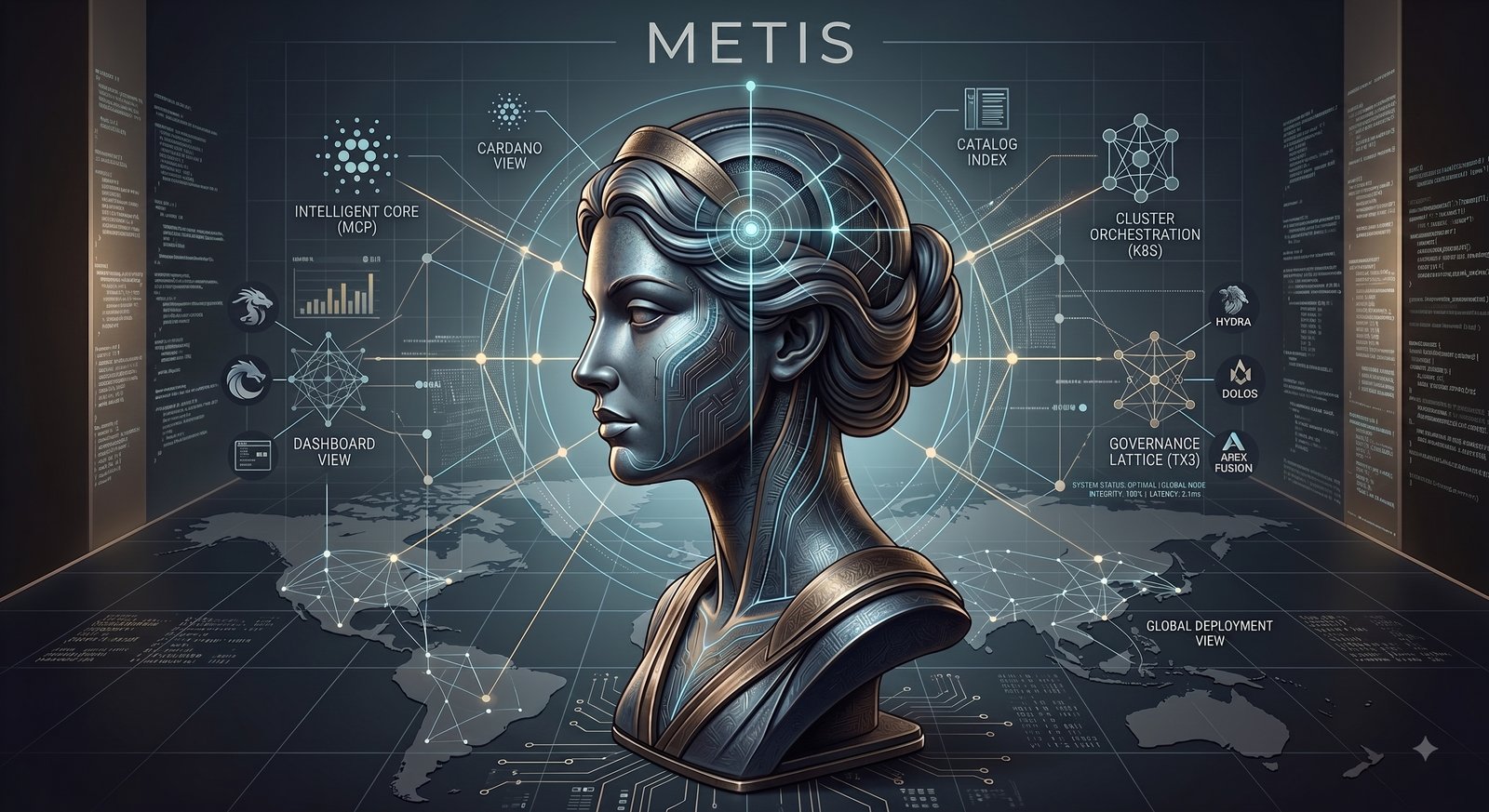
The underlying model is strictly “Bring Your Own Cloud”: the operator retains absolute dominion over their hardware, network, and private keys, while Metis handles the standardization of lifecycle management, secrets, and observability.
The supernode-mcp Server: When AI Speaks Directly to the Cluster
One of the most fascinating aspects of Metis—and the true turning point in my experience—is its MCP server, named supernode-mcp and developed entirely in Rust.
The Model Context Protocol (MCP) is an open standard that allows AI agents to interact with external systems securely using typed tools, resources, and structured prompts. In practice, this completely changes how you manage infrastructure. You no longer have to hunt through forums or repositories for exact Helm flags, or manually draft typo-prone YAML manifests. You simply tell the agent directly: “Install an Apex Fusion relay” or “Check the status of the block producer on the local cluster,” and the agent orchestrates the correct tool call.
The supernode-mcp server natively exposes over 17 operational tools covering the entire SuperNode lifecycle:
- Installing, inspecting, updating, and deleting Helm-based workloads.
- Real-time querying of logs, metrics, and node health status.
- Integrated secret management via the Vault Secrets Operator, ensuring strict separation between runtime secrets consumed by workloads and operator administrative credentials.
- Automated generation of cryptographic keys for Hydra.
- Updating and syncing storage snapshots for Dolos nodes.
Additionally, the repository includes a catalog of 25 operational skills designed specifically for agents to execute complex step-by-step flows—from spinning up a Cardano stake pool from scratch to rotating KES keys or troubleshooting critical incidents in Hydra or Midnight nodes.
Working with this setup eliminates the blind friction of the console. The agent validates each extension’s configuration schema before deploying, shows you a clear execution plan, and verifies via checks (gates) that the service is responding correctly before marking the task complete.
From Lab to Metal: Our Apex Fusion Prime Testnet Implementation
During our latest technical session, we decided to push Metis to the limit by implementing a complete Apex Fusion Prime Testnet network using a local Kind-based environment. Following a rigorous progressive validation methodology, we executed the following workflow:
1. Cluster Preparation and Local Bootstrap
We started by initializing the test environment using the bootstrap script provided in the official repository:
cd bootstrap
./bootstrap.sh \
  --provider kind \
  --version 0.1.0 \
  --config ./kind/config.yml
This script not only provisions the local Kubernetes cluster, but also automatically applies provider defaults, pre-installs the Vault Secrets Operator CRDs, and deploys the Metis control-plane Helm chart. We verified that all cluster dependencies and storage classes were healthy before proceeding.
2. Declarative Apex Fusion Deployment
Rather than improvising manual deployments, we used official extensions from the Metis catalog (apex-fusion-relay and apex-fusion-block-producer). The agent read the extension configuration schemas, validated the required parameters against the catalog, and generated the deployments via Helm. The entire process was recorded in the MCP server’s audit events.
3. Network Tip Synchronization and Verification
Once the nodes were deployed, we closely monitored the synchronization process with the Prime Testnet network. Metis’s integrated metrics and exposed resources allowed us to track the chain’s evolution in real time, confirming that the nodes reached and maintained the network tip without experiencing drift or memory leaks.
4. Resource Measurement and Resilience
Without the misleading abstraction of a commercial cloud provider, we were able to measure CPU, RAM, and local disk storage consumption with pinpoint precision during the peak demands of initial synchronization. Similarly, we tested failure recovery and controlled restart scenarios, verifying that the control plane recovered its desired state automatically and deterministically.
Why Metis Is a Game-Changer for SPOs
TxPipe’s thesis over the years has remained consistent: blockchain infrastructure must leave behind artisanal shell scripts inherited from the pre-Shelley era and evolve toward modern, modular, and composable standards. Tools like Ogmios, Demeter, and Dolos proved that access to the Cardano network could be decoupled and radically optimized. Metis represents the pinnacle of that vision.
For a stake pool operator, the implications are profound:
- Operational Efficiency: The exact Kubernetes infrastructure you use to operate your Cardano nodes can be reused to validate Partner Chains and emerging networks without fragmenting your team or duplicating maintenance efforts.
- Sovereignty and Control: By maintaining the “Bring Your Own Cloud” model, you are never tied to centralized platform restrictions or abusive data transfer fees.
- Advanced AI Collaboration: Working with agents backed by Metis’s MCP server doesn’t feel like a marketing gimmick or a fragile script; it feels like a robust engineering layer that supercharges your operational capacity.
Metis’s source code is available under the Apache 2.0 license at github.com/txpipe/metis. If you are an SPO, infrastructure developer, or simply passionate about the future of decentralized networks, my direct recommendation is not to limit yourself to passive reading of the documentation. Spin up a local cluster with Kind, connect an AI agent via the MCP server, and experience firsthand what operating in the SuperNode era actually means. The initial learning curve exists, but the performance and peace of mind you get on the other side are well worth every line of configuration.
Related reading: Ouroboros Leios: What It Is and How It Aims to Scale Cardano.
ChileStakePo (CHIL) is a Cardano stake pool operated from Chile. We research, test, and document the tools that elevate the technical standards of the entire operator ecosystem.